

How AI and Dynamic Routing Cut Costs and Optimize Logistics


Key Takeaways
- AI-driven route optimization is an advanced version of dynamic routing that makes route adjustments on the fly based on traffic data, weather conditions, new orders, or changes in delivery windows. [What Is AI Route Optimization and How Does It Work]
- Dynamic routing is built on the Vehicle Routing Problem (VRP), augmented with real-world constraints such as vehicle capacity, delivery time windows, and driver hours. [What Is AI Route Optimization and How Does It Work]
- AI route optimization and classic dynamic routing are not the same thing: one reacts to problems you programmed, the other constantly reevaluates the entire route according to real conditions. [AI Route Optimization vs. Classic Dynamic Routing]
- Route and fleet optimization is the biggest use case for agentic AI in logistics, with published total cost benefits of 15-30%. [Key Benefits of AI Route Optimization]
- Most rollouts fail due to data quality, staff trust, or lack of integrations, not the algorithm itself. [Common Challenges and Mistakes]
- A successful rollout goes through five phases: audit, buy-vs-build, pilot, integration, and incremental scaling, in that order. [How to Implement AI Route Optimization Successfully]
Logistics companies aren’t just dealing with a rough patch right now – they’re operating in what the industry’s own annual benchmark calls a structural shift, not a temporary one. The 2026 State of Logistics Report puts U.S. business logistics costs at $2.4 trillion, or 7.8% of GDP, and names labor shortages and energy volatility as two of the five forces reshaping the industry going forward – not two problems that will resolve on their own.
I’ve talked to enough logistics executives to know what that actually feels like day to day: fuel costs that swing without warning, drivers who are harder to find and keep than they used to be, and customers who now expect the kind of real-time visibility that manual dispatching was never built to give them. None of these are new complaints, but together they’ve reached a point where spreadsheets and dispatcher experience – the tools that got most fleets this far – simply can’t keep up with how fast conditions change – which is exactly why logistics optimization has stopped being optional.
This is exactly where AI route optimization comes in, and it’s worth being precise about what that term actually means before going any further, because “smart routing” gets thrown around loosely in this industry. Let’s start with a working definition, then walk through how these systems actually make routing decisions in practice.
What Is AI Route Optimization and How Does It Work
AI route optimization is software that decides, in real time, which vehicle should go where, in what order, and by which path – based on live conditions rather than a route someone planned the night before. Typically, the routing module is part of a larger transportation management system (TMS), the system that automates and coordinates the transportation side of a company’s operations: assigning loads, tracking shipments, and giving dispatchers one place to see what’s happening across the fleet.
Looking For a Transport Management System?
Review our case study on creating a customized TMS for a logistics company.
Learn MoreHere’s the part that actually matters for how well it works: the logistics route optimization module isn’t running on guesswork. At its core is a well-studied optimization problem called the vehicle routing problem (VRP), which answers three questions for every vehicle in the fleet – which customers it should serve, in what sequence, and how to do that at the lowest possible cost. Real fleets add layers on top of the basic VRP: capacity constraints so a truck never gets overloaded, time windows so a delivery doesn’t show up outside the slot a customer agreed to, and driver hour rules so a route doesn’t quietly violate labor regulations. When an executive sets a goal like “cut fuel costs by 15%,” the VRP model is what translates that into an actual constraint the algorithm optimizes against – it’s the bridge between a business target and a specific route on a specific day.
What feeds that decision is a constant stream of live data: incoming orders, vehicle locations and capacity, current traffic conditions, and, increasingly, weather data that can flag a delay before it happens rather than after.
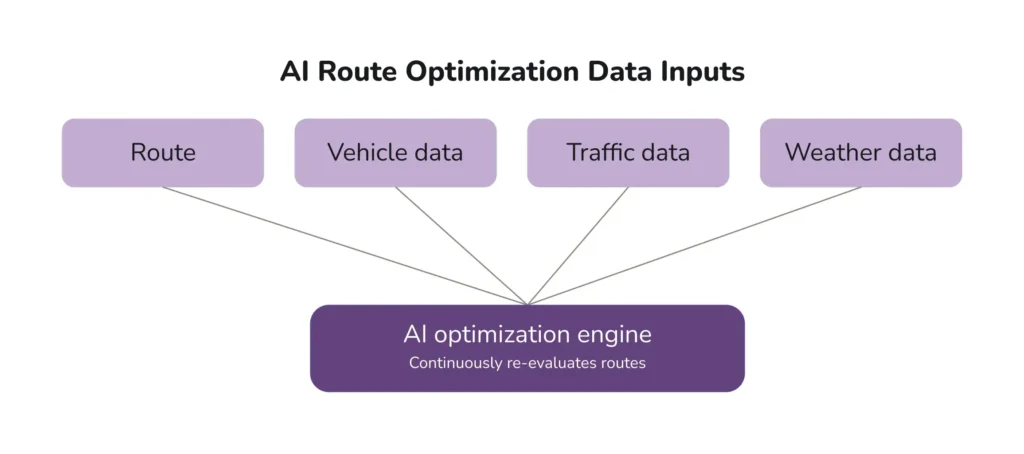
The AI engine weighs all of it against the constraints above and outputs a route recommendation, which the driver then executes. And because none of those inputs stay fixed for long, the system keeps adjusting the plan as new data comes in, rather than locking in a route at 6 a.m. and hoping the day goes as planned.
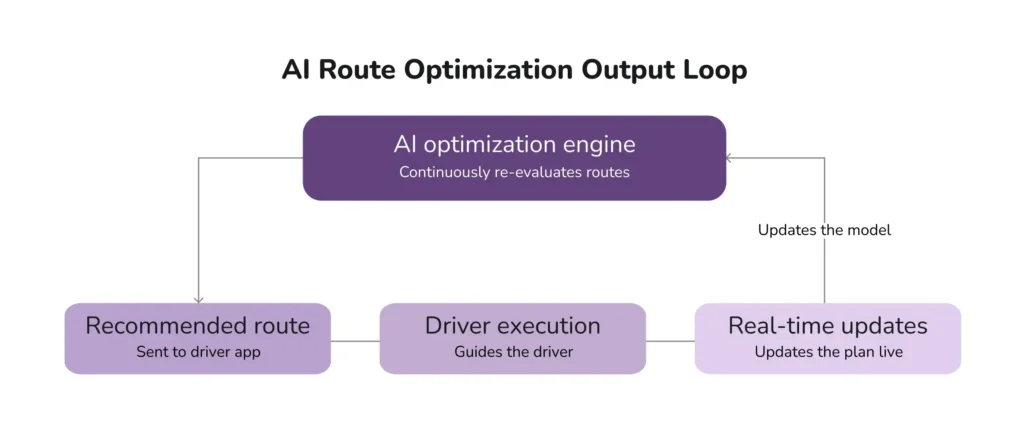
This is also where I’d point out something that gets lost in a lot of vendor pitches: the model is only as good as the data going into it. I’ve seen companies buy a capable routing platform and then feed it incomplete vehicle data or outdated customer time windows – and wonder why the “optimized” routes still don’t match reality. The algorithm of real-time route optimization isn’t the hard part anymore – feeding it clean, timely data consistently is, and that’s usually solved through IoT sensor integration on the vehicle side and reliable, fast APIs that keep data flowing from every third-party source a fleet depends on.
AI Route Optimization vs. Classic Dynamic Routing
Before going further, it’s worth clearing up a distinction that gets muddled a lot in logistics content: static routing and dynamic routing don’t mean the same thing here as they do in networking, where the terms describe how data packets find their way across a network. In logistics, they describe how vehicle routes get planned.
Static routing means a route is planned in advance – usually the night before or first thing in the morning – and then followed as-is for the day. It works fine when conditions are predictable, or when the route does not involve a significant number of variables, such as dynamic delivery windows, road closures, or high traffic variability. It breaks down the moment something unplanned happens, because there’s no mechanism to adjust once the driver is on the road.
Dynamic routing means the route can change after the vehicle has already left, in response to something that happened after the plan was made. But “dynamic” on its own doesn’t tell you how that adjustment gets made – and that’s where the real gap in capability shows up.
Classic, rule-based dynamic routing reacts to conditions using predefined if-then logic: if a road closes, reroute around it; if a delivery is cancelled, skip that stop. It’s a real improvement over static planning, but it only handles the specific triggers someone thought to program in advance.
AI route optimization doesn’t wait for a predefined trigger. It continuously re-evaluates the entire route plan against live traffic, weather, new incoming orders, and vehicle status, weighing trade-offs a fixed rule never could – for example, deciding that absorbing a short delay on one stop now prevents a much bigger one three stops later.
Most companies I’ve worked with don’t jump straight from static to full AI optimization – they pass through the classic dynamic stage first, often without realizing it’s a distinct step with its own ceiling. That’s a fine path to take, but it’s worth knowing in advance that the rule-based stage will eventually run into the same wall: someone has to keep writing new rules for every new type of disruption, and logistics has never been short on new types of disruption.
Key Benefits of AI Route Optimization
The most significant benefits of AI in logistics are realized in route and fleet optimization. Within the agentic AI market for supply chain and logistics, Fact.MR projects that route and fleet optimization will account for 35% of all logistics-function spending in 2026, ahead of warehouse automation, shipment tracking, and supplier management combined. That’s not surprising once you consider why: it’s a high-volume, repeatable workflow with metrics that are easy to measure, which makes the return on investment easier to prove than almost anything else on this list.
And that’s really the point I want to make before showing you any numbers: “benefits” in a sales deck usually means vague phrases like “increased efficiency.” What you actually want to track is a short list of specific KPIs, because those are what tell you whether the system is paying for itself:
- Cost metrics: cost per delivery, cost per mile, cost per stop
- Service metrics: on-time delivery rate, average route duration
- Utilization metrics: empty miles (%), fleet utilization, driver utilization, planning time reduction
If a vendor can’t tell you how their platform moves these specific numbers, that’s worth asking about directly.
Here’s what the published research shows across these categories:
Sources: Fleet Rabbit, 2026 / DHL Freight, 2025. These are industry benchmarks, not guarantees.
If you want a concrete example of what these numbers mean in practice, take a look at the experience of the Ukrainian logistics giant “Nova Post”. The company’s IT arm, Nova Digital, built a route optimization tool called RouteStripe and tested it across millions of the company’s own delivery operations. According to the Director of the Address Delivery Department at Nova Post, the result was a 30% cut in logistics costs and a 33.9% fuel optimization – savings that came directly from adapting routes to the company’s actual delivery patterns instead of a fixed plan.
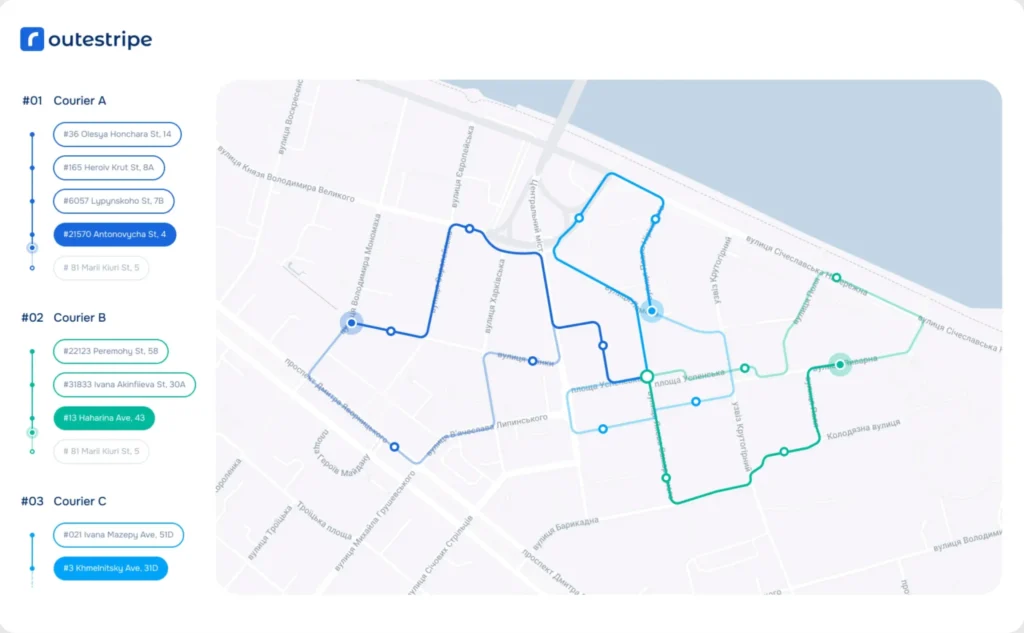
I’d add one thing from my own experience here that doesn’t show up in vendor case studies: the biggest gains rarely come from the algorithm getting smarter over time. They come in the first few months, once a company finally has clean, structured data about its own operations for the first time – data that was previously scattered across dispatcher notebooks, paper logs, and someone’s memory of “how we’ve always done it.”
Considering AI for routing, dispatching, or fleet optimization?
Let’s evaluate which use cases make sense for your operation — before investing in complex models.
Book a Free ConsultationCommon Challenges and Mistakes
Rolling out AI-driven dynamic logistics route optimization is a real transformation for a business of any size, not just a software swap. Despite the strong return on investment it typically delivers, the process never comes without friction, and the same handful of obstacles tend to show up on nearly every project. Based on my own experience, industry material, and conversations with peers in the field, here are the barriers that consistently get in the way of a successful rollout.
Data Quality
If I had to rank these problems by how often they sink a project, this one is first by a wide margin. Machine learning in logistics can only be as good as what it’s fed, and most fleets underestimate how messy their operational data actually is – inconsistent address formats, outdated vehicle specs, delivery windows that live in someone’s email instead of a system. You’ve definitely heard this expression, “garbage in still means garbage out” – no matter how sophisticated the model, without thorough data cleaning and constant data updates, even the best AI will generate unusable routes.
Driver and Dispatcher Resistance
Experienced drivers have spent years learning their territory, and a route recommendation that contradicts what they “know” feels less like help and more like being second-guessed by a machine that’s never actually driven the road. Add to that a real fear of being monitored more closely, and you get a predictable outcome: drivers quietly ignore the suggested route, and dispatchers manually override it because they don’t trust it either.
Even UPS ran into this with ORION – by their own account, most drivers didn’t trust the system at first, precisely because they’d driven the same streets for years and were confident they already knew the fastest way. The system only earns trust once it proves itself repeatedly on routes people already know well, which means the rollout plan matters as much as the algorithm.
The Constraint Gap
A route can look perfectly efficient on a map and still fail the moment it hits the road, because the system only optimizes for what it was told to account for. If nobody configured weight and dimension limits, driver hours-of-service rules, specific client delivery requirements, or the fact that a certain street doesn’t allow trucks after 6 p.m., the algorithm has no way of knowing that. It will happily route around a constraint it was never told exists.
Integration Gaps
In most fleets I’ve looked at, the TMS, ERP, WMS, telematics, and order management systems weren’t built to talk to each other – they were bought at different times, from different vendors, for different reasons. Without an adequate level of integration, someone will eventually have to manually transfer data between systems, and if we also factor in differences in data entry standards, we’ll end up with delays and transcription errors. When that happens, transportation route optimization stays an isolated tool that a few people use on the side, instead of becoming part of how the operation actually runs day to day.
No Baseline KPIs Before Implementation
This one is easy to miss because it doesn’t cause a visible failure – it just quietly makes success impossible to prove. If nobody measured cost per mile, on-time delivery rate, or empty miles before rolling out the new system, there’s no number to compare against six months later. I’ve seen genuinely successful projects get treated as disappointments internally simply because no one could point to what things looked like beforehand.
How to Implement AI Route Optimization Successfully
A successful rollout strategy is, first and foremost, about closing the gaps described in the section above. Industry advice on this topic is everywhere, and most of it repeats the same handful of ideas in different words – so instead of adding to that pile, here’s what this actually looks like from a C-level seat, phase by phase, with the decisions that matter at each one.
Phase 1: Audit Data and Infrastructure
Before anyone talks to a vendor, you need an honest answer to one question: is our data good enough to feed an optimization engine? That means checking address geocoding accuracy, how complete your weight and dimension data actually is in your CRM/WMS/ERP, and whether delivery time windows exist in a system at all or just in someone’s head. At the same time, verify the infrastructure side – GPS trackers on vehicles, driver-facing mobile apps, and whether your current stack can even expose an API for a new system to plug into.
This is also when you lock in baseline metrics: cost per delivery, average mileage, on-time-in-full rate, fuel spend. Skip this step, and you’ll have no way to prove ROI later, no matter how well the rollout goes.
To audit your internal systems, you can turn to your ERP system provider or to logistics software developers, such as Dinamicka Development.
Phase 2: Decide Buy vs. Build
This is the strategic call only you can make, and it deserves more than a gut-feel answer. Buying logistics route optimization software gets you running in 2–4 months with lower upfront cost, but limits how closely the system can match your specific processes. Building a custom software product makes sense when your operation has constraints or scale that off-the-shelf platforms weren’t designed for – but it’s a real commitment, not a shortcut. If you’re weighing this trade-off in more depth, I’ve written a longer breakdown of the build-vs-buy decision that applies just as much here as it does to any other software decision.
Whichever direction you lean, run the total cost of ownership over three years, not just the sticker price – licensing, cloud infrastructure, map/traffic API costs, and support all add up differently depending on which path you take.
Phase 3: Run a Proof of Concept and Pilot
Limit the first test to one region, one depot, or a small slice of the fleet – enough to get a real signal, not so much that a bad configuration becomes a company-wide problem. Have your most experienced dispatchers actually review the routes the system proposes before trusting them blindly. If the algorithm sends a truck under a bridge it can’t clear, that’s exactly the kind of edge case you want surfacing now, not after full rollout.
A realistic pilot usually shows its first real gains here – often in the 5–15% range on cost or planning time – which gives you an actual number to bring back to the rest of the organization instead of a promise.
Phase 4: Integrate Systems and Manage the Human Side
Two things need to happen in parallel here, and neither works without the other. On the technical side, connect the new system directly to your ERP/WMS so orders flow in and finished routes flow out to the driver’s app automatically – without someone copying data between systems by hand.
On the human side, this is where you actually deal with the resistance covered earlier. Tie a route-adherence metric to dispatcher and driver performance, and connect part of their incentive to the savings the system is actually delivering. That single change tends to do more for adoption than any training session, because it turns the system from something imposed on them into something that benefits them directly. Build a simple dashboard for yourself too – deviation rates, fuel overruns, KPI trends – so you’re watching the same numbers your team is.
Phase 5: Scale and Keep the Model Learning
Once the pilot has held up, extend it region by region rather than flipping the switch everywhere at once. As you scale, the system should keep improving on its own – feeding back real driver data so it learns, for example, that a specific stop consistently takes longer than planned, and adjusts the time budget for that location automatically instead of making the same planning error every day.
Here is a brief checklist for C-level executives outlining the criteria for readiness to move on to the next stage.
The one rule that holds across every phase: don’t scale past a stage where your data or your people aren’t ready – that’s precisely how a pilot that looked successful turns into a rollout that quietly fails.
Conclusion
Route optimization has moved from a competitive edge to a baseline requirement – the data throughout this article makes that hard to argue with. But the technology itself was never really the hard part. The fleets that get real value from it are the ones that treat data quality, integration, and driver buy-in as seriously as the algorithm – and the ones that skip that groundwork are the ones whose “AI project” quietly turns into a dashboard nobody actually uses.
If you’re weighing whether this is worth the investment for your operation, that’s exactly the kind of conversation worth having before committing to a vendor or a build. Get in touch with our team, and we’ll help you figure out where you actually stand.
Latest writings

What Is Search Engine Marketing (SEM)

MVP Development for Startups in 2026: Speed Up Launch with AI