

PoC vs Prototype vs MVP: Differences, Use Cases, and How to Choose in 2026

- PoC vs Prototype vs MVP at a Glance
- What Is a Proof of Concept (PoC)?
- What Is a Prototype?
- What Is an MVP?
- How to Choose Your Next Experiment
- How Is AI Changing PoC, Prototype, and MVP Development in 2026?
- One AI Product, Three Different Experiments
- Common Mistakes When Choosing
- Choosing What to Build Next
- FAQ


Key takeaways
- A proof of concept tests whether a specific technical approach works under the project’s constraints, not whether customers want the product. [What Is a Proof of Concept?]
- A prototype tests whether users understand and complete a workflow, whether it uses clickable screens or working code. [What Is a Prototype?]
- An MVP delivers real value to users while testing a core business assumption, with payments and infrastructure determined by that experiment. [What Is an MVP?]
- Choose a PoC, prototype, or MVP based on the greatest unresolved risk rather than following a mandatory sequence. [How to Choose Your Next Experiment]
- AI-generated code and interfaces still require engineering review before they can support real users reliably. [How Is AI Changing PoC, Prototype, and MVP Development in 2026?]
- Define success criteria before each experiment so the evidence guides whether to continue, revise, or stop. [Common Mistakes When Choosing]
One of the most common mistakes made by most startup founders and AI service founders is to rush out and look for a freelancer or development team and start full development of an untested product. As a result, the budget is wasted on a product that turns out to be either technically impossible, too complicated for the user, or that no one needs at all – I already wrote about this in the article “How to Validate a Startup Idea Before Building an MVP“, where I noted that CB Insights consistently identifies these very reasons as causes of startup failure.
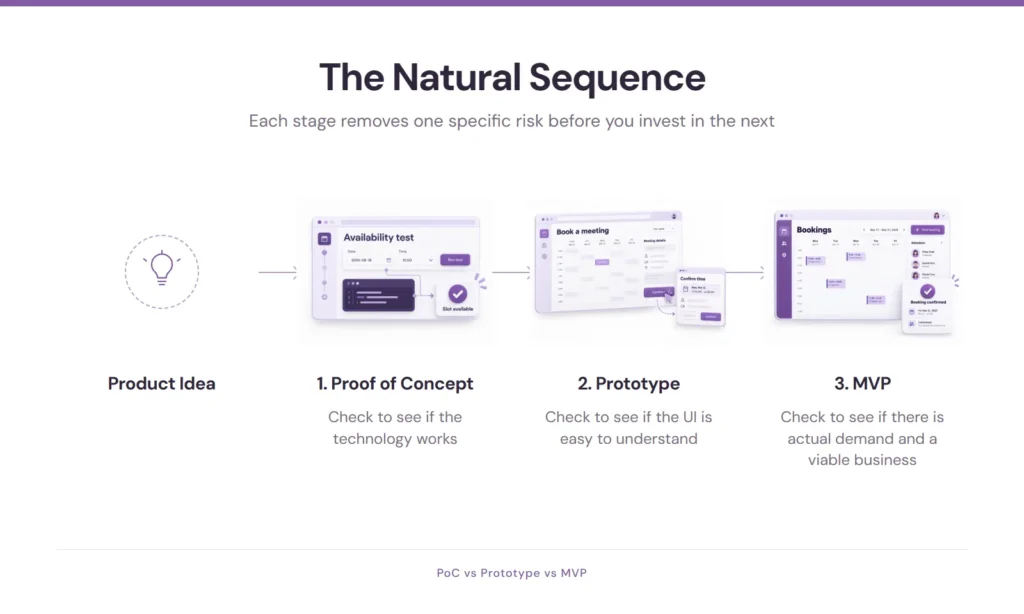
To avoid burning money unnecessarily, product management employs three sequential filters: a proof of concept (PoC), a prototype, and a Minimum Viable Product (MVP).
Each tests a different kind of risk:
- A POC verifies whether an idea can be technically implemented at all.
- A prototype verifies whether users understand the interface and whether the user flow is logical.
- An MVP verifies whether real customers are willing to use the product and pay for it.
Some projects run all three in order; just as many settle real uncertainty with only one or two, in whichever order the risk actually shows up.
The POC vs MVP vs Prototype question sounds like it’s a choice between three options.
But I want to emphasize an important point: these aren’t alternative options from which you choose any one. This is a step-by-step de-risking framework.
Below, we break down the differences between PoC, Prototype and MVP, when each stage is needed and when it can be skipped, the role of AI tools in 2026 and the decision-making algorithm for your project. This guide gives you a way to pick the next experiment based on what’s genuinely unproven in your project right now.
PoC vs Prototype vs MVP at a Glance
PoC, prototype, and MVP answer different questions – compare them side by side before the detail below.
Tool, polish, or whether real code sits behind an artifact doesn’t decide which of these three it is: a prototype can run on a real, partial backend, and a technically sound PoC can have rough UX – nobody’s evaluating UX there. Cost and time follow the hypothesis and scope, not a fixed price per stage, so no separate price table follows here.
What Is a Proof of Concept (PoC)?
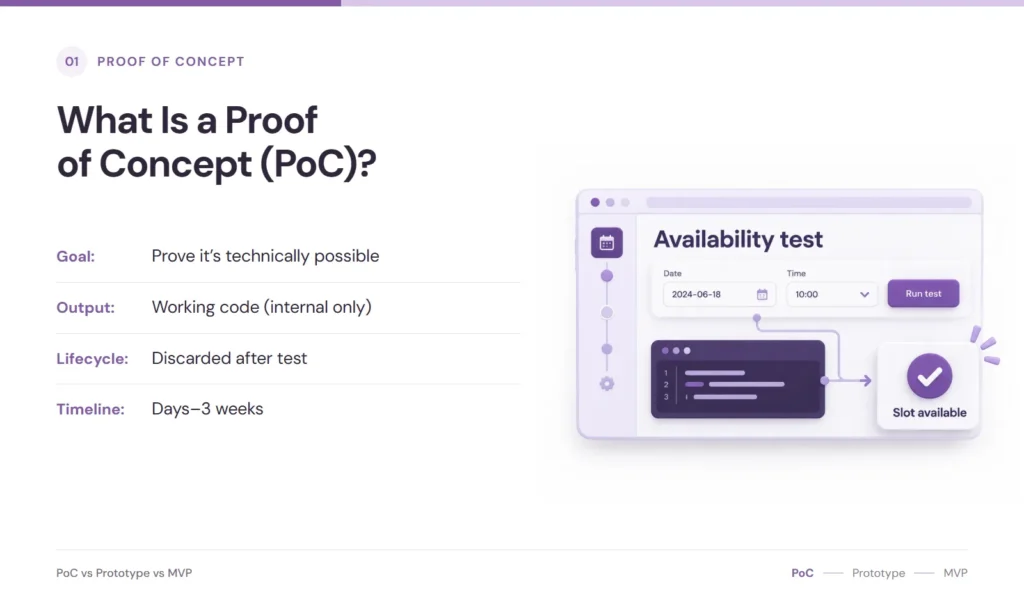
A PoC is a minimal technical experiment that answers one question: is it even technically possible to build this solution. Not what it will look like, not whether users will like it, but whether it works in principle or not.
Key parameters of PoC:
- Goal: to confirm technical feasibility;
- Audience: the internal team, CTO, sometimes investors with really complex technical solutions;
- Output: rough working code, a script, or architecture test – without an interface, error handling, or documentation;
- Timeline: from several days to 2-3 weeks;
- Lifecycle: almost always gets scrapped immediately after testing.
You need a PoC when there’s real technical uncertainty: connecting to a legacy system with no open API, processing unusual data volumes, chaining several AI models together.
The deliverable isn’t “disposable” in the sense of undocumented – it’s a short written record: what was tested, the result, what the test does and doesn’t cover, and a decision to continue, revise the approach, or stop. A negative result is a useful result: finding out in a week that an approach doesn’t work is the point, and it’s worth writing down so the next attempt doesn’t repeat it.
The proof of concept vs mvp comparison comes down to one thing: PoC checks technical feasibility, while an MVP checks market demand. The difference between proof of concept vs prototype lies on a different axis: PoC checks whether the technology works, while a prototype checks whether the user understands the interface. A technically functional PoC can have terrible UX, and that’s okay, because no one is evaluating UX there.
When Does an AI Product Need a PoC?
A separate PoC for an AI component earns its cost when at least one of these is genuinely unknown: how the model performs on your actual data and edge cases rather than a generic benchmark, what a wrong answer costs you, and what real latency and per-request cost look like under realistic load.
A product built on retrieval-augmented generation (RAG) or another LLM-based component is one example where these unknowns commonly apply – not a stand-in for every AI feature, and not every RAG system needs a vector database specifically.
A PoC for an AI product tests three things that cannot be calculated in theory:
- Accuracy of responses and hallucinations – whether the model is capable of consistently handling a narrow business topic without fabricating facts;
- The quality of the RAG architecture – how accurately the vector database extracts the necessary context from internal documentation;
- Latency and cost of inference – how much will one request actually cost under load and whether the user will have to wait for a response.
Say a company wants to build an AI assistant that answers customer questions using an internal knowledge base. The PoC answers exactly two things – does the RAG system give accurate answers on the company’s actual data, and what would it cost per query at a thousand requests a day.
If those unknowns don’t apply – a well-understood integration with a model already documented on similar data – a separate PoC may add little. None of this requires putting UX work on hold: prototype work on the surrounding flow can run in parallel, since the two test different things.
What Is a Prototype?
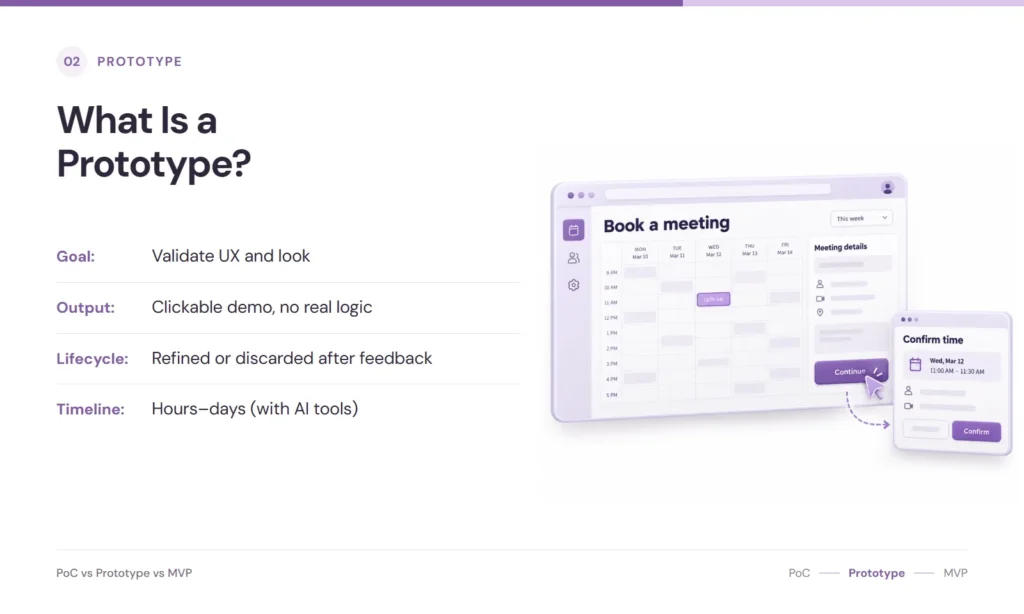
A prototype is a simulation of a product that shows how it looks and how it feels to use, without the actual functionality under the hood. The goal is to test UX and user flow, as well as to present the idea to investors or stakeholders before writing production code. However, a functional prototype can include real code and a real, if minimal, backend – code in the artifact doesn’t disqualify it from being a prototype, and a missing backend was never actually the test.
Prototypes come in different depths:
- Paper wireframes – quick sketches for talking through the basic logic;
- Low-fidelity wireframes – plain structural blocks in Figma, no colors or design;
- Clickable prototypes – interactive mockups that simulate navigation between screens;
- Functional prototypes – some of the logic actually runs, though the data is mostly fake.
Success here means someone completed the target task, and you found the points where they got stuck or confused – not that the design looked polished.
Showing a prototype to an investor or a room of stakeholders and getting a good reaction is a UX and communication signal, not evidence of demand: people saying a mockup looks good isn’t the same as people committing money or repeat use to it. That is the difference between a prototype vs MVP.
A clickable prototype might look like a finished app, but there’s nothing behind the “Sign Up” button. An MVP actually registers the user in a database. The same logic defines proof of concept vs prototype: PoC proves the tech works; a prototype proves a human can figure out the interface.
That doesn’t mean a prototype tells you nothing about the market. It means design approval on its own isn’t sufficient evidence that people will actually adopt or pay for the product.
With modern AI tools, experienced specialists can develop a prototype from a few hours to a few days, depending on the complexity of the flow. Five years ago, the same thing took one or two weeks of a designer’s work.
I’ll tell you even more – some of our customers increasingly come with a ready-made prototype developed on Lovable or Base44, which helps teams to assess the customer’s vision and the main flow right from the very beginning. Next, it is a matter of designing a reliable architecture.
What Is an MVP?
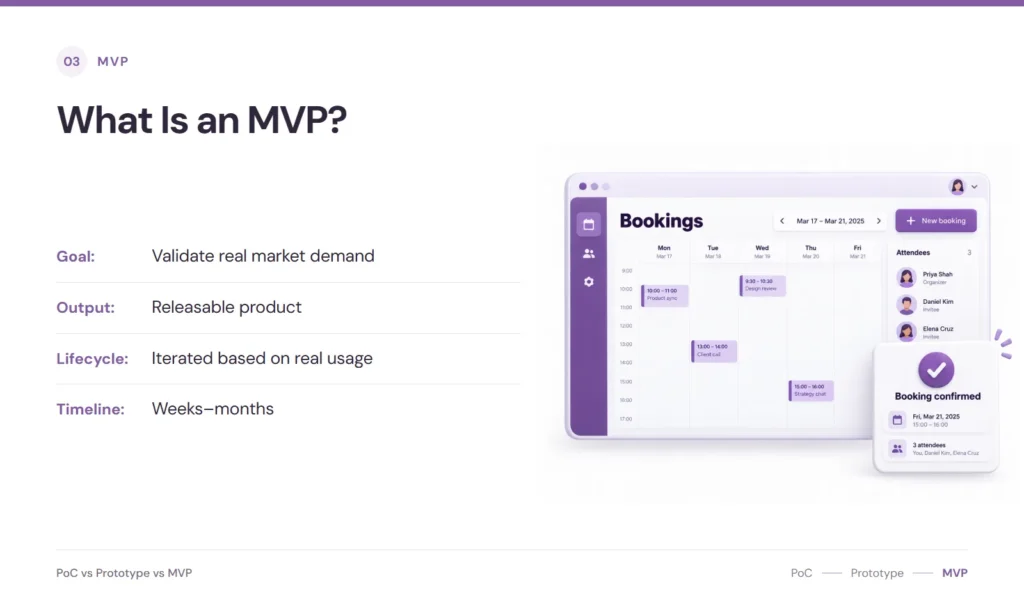
MVP, or Minimum Viable Product, is the first working version of a product that real users can install, sign up for, and use to solve an actual problem. The point of an MVP isn’t showing an idea – it’s checking whether the market will pay for it.
Key parameters of MVP:
- Goal: validate the business model and real demand with real users
- Audience: the first paying, real customers
- Output: a working service with a full database, authentication, and payment processing
- Timeline: a few weeks to a few months, depending on scope
Learn more about our MVP development service.
The key difference between minimum viable product vs prototype is that MVP is a working product, prototype is a simulation. In a prototype, the “Pay” button might go nowhere. In an MVP, that same button actually runs a transaction through, say, Stripe, and charges the card.
The MVP vs proof of concept comparison comes back to the same logic: PoC checks technical feasibility, MVP checks market demand. A product can work great technically and still turn out nobody wants it — two separate risks, and solving one doesn’t take care of the other.
This lines up with the Lean Startup idea of validated learning as the actual unit of progress for a new product: the point of an MVP is evidence about a real assumption, gathered through genuine use, not a feature checklist.
The biggest mistake founders make here isn’t technical complexity; it’s scope creep. We wrote in more detail about defining what belongs in a first release, and how to check demand before development starts, in “How to Validate a Startup Idea Before Building an MVP“. An MVP tests one assumption at a time; it doesn’t prove an entire market wants the product in a single launch, and most MVPs go through more than one round before that verdict is clear.
How to Choose Your Next Experiment
When the uncertainty is about the problem or demand itself, see our guide on how to validate your startup idea before building an MVP – no need to build a PoC first just to confirm the framework was followed in order.
Do You Need All Three?
So, does every project have to go through all three stages of its life cycle? The short answer is no. If a prior project already answered one of these questions with solid evidence, that evidence carries over, and the corresponding step adds little.
When you can skip a step:
- Skip PoC if you’re building a standard web service on a proven stack (Node.js, Python, React, PostgreSQL). A familiar tech stack doesn’t by itself rule out integration, data, or scale risk, though;
- Skip Prototype when the team knows the niche well, uses ready-made UI kits, and builds interfaces around patterns users already know
- Go straight to MVP only when the stack is standard, the team’s shipped similar things before, and demand is already confirmed by real pre-orders or contracts
The full PoC to Prototype to MVP sequnce matters most for complex B2B systems, deep tech, and AI products with a lot of uncertainty. This sequence is just one piece of a bigger development process — we cover how it fits into the full software development lifecycle, from idea to launch, in our custom software development guide.
Not Sure Which Stage You’re At?
A 30-minute call is enough to map your idea against this table and tell you exactly where to start.
Book a Free ConsultationWhat Determines Time and Cost?
Time and cost track concrete drivers: test complexity, access to real data or users, number of integrations, the reliability the test needs to demonstrate, and how many rounds of iteration it takes to reach a usable answer – including rework time, not just how fast a tool generates the first version of the code.
None of this makes one stage reliably cheaper by default – a PoC for a well-understood integration can cost less than a prototype needing several rounds of user testing, and the reverse happens just as often.
How Is AI Changing PoC, Prototype, and MVP Development in 2026?
And now the most interesting thing – how did artificial intelligence affect these three stages? Cardinally. AI tools haven’t changed the logic behind these three stages – they’ve changed how fast and cheap it is to get through each one. AI tools now handle a meaningful chunk of the mechanical work across all three stages: scaffolding a backend, generating UI variations from a description, writing first-draft scripts and tests.
Developers with generative AI complete typical code tasks twice as fast compared to working without AI assistants. But what about the developers – the customer himself – having understood a little about such things as Lovable, can make a prototype of his future product in a few days and present it to potential investors.
For the sake of transparency, I should note that the AI tools available today only cover something relatively simple tasks, like developing prototypes or small websites. For projects with complex architectural solutions, you can’t do without experienced engineers with a product mindset. This, in fact, is confirmed by the market trend.
Still, let’s take a look at a few AI tools and how to use them at different stages of development:
At the PoC stage, Langflow and Make let you wire LLMs, vector databases, and third-party APIs together through a visual builder instead of writing integration code by hand. Claude Projects and Cursor handle the code-heavy side – turning raw data or a plain-language description into a working script. Supabase AI covers the database layer, generating schema and queries in minutes. According to our internal monitoring, these approaches cut PoC development time by 40-60% for typical technical checks.
Developing a prototype with AI tools like Lovable or Figma AI allows you to create interface prototypes based on text prompts. v0 by Vercel is our absolute leader in web prototyping – you just describe the interface in words, and the AI instantly generates working components. After that, you can refine the design step by step.
Fast MVP development with AI tools is also an interesting process – you can take a prototype designed with AI and turn it into actual production development through Cursor and Copilot, while tools like Supabase AI now handle a chunk of what used to be pure engineering work – database schemas, access policies, authentication. Engineers are left with the most critical part of the process – assessing whether the generated data model structure actually fits the product’s data model and security requirements, not typing it out by hand.
Keep in mind: a schema or test that looks plausible isn’t the same as one that’s been reviewed.
The main takeaway: AI speeds up every stage but doesn’t replace product thinking or architecture decisions.
One AI Product, Three Different Experiments
To demonstrate the practical application of the aforementioned methodology, I’ll try to provide a hypothetical example. I’d like to note that this is not a completed Dinamicka Development project or a real client case study.
Let’s suppose that the product is a B2B assistant that answers employees’ questions using the company’s internal knowledge base and documentation.
PoC
- Hypothesis: A retrieval-augmented generation (RAG) setup can answer real employee questions accurately enough, at a sustainable cost per query.
- Experiment: Run it against a representative sample of real documents and realistic questions – including ambiguous, out-of-scope ones – against a baseline such as a human agent or keyword search.
- Evidence: Accuracy against criteria agreed before the test, rate and severity of wrong answers, latency, and cost per query at expected volume.
- Decision: Continue to a prototype if accuracy and cost clear the pre-set thresholds; narrow scope to where accuracy is strongest; change the retrieval approach; or stop.
- What remains unknown: Whether employees will trust and use the answers day to day, and whether the numbers hold outside the test sample.
Prototype
- Hypothesis: Employees can find, evaluate, and act on an AI-generated answer without confusion, including recognizing when the system is unsure.
- Experiment: A clickable or partly-functional flow: search, an answer with cited sources, a low-confidence signal when relevant, and a way to flag a wrong answer or escalate to a human.
- Evidence: Whether employees complete the task, check the cited sources, notice and act on a low-confidence flag, and where they get confused.
- Decision: Move to an MVP if the flow holds up; revise the interaction – how uncertainty is communicated, for example – and retest if it doesn’t.
- What remains unknown: Whether this holds up with the AI’s real, occasionally wrong answers in daily use, and whether use continues once the novelty wears off.
MVP
- Hypothesis: A defined group of employees will use the assistant for real questions, repeatedly, in place of their current way of finding answers.
- Experiment: Release to one team or use case, with real documents, real questions, and a working way to escalate to a human when the system is wrong.
- Evidence: Task completion, repeat use over a set period, how often a human steps in, cost per successful answer. Willingness to pay only if monetization is the hypothesis being tested.
- Decision: Expand if the numbers hold; keep iterating on the same scope if they’re close; stop or rethink if usage or accuracy don’t hold outside the pilot.
- What remains unknown: How the numbers hold at larger scale, across more document types, and over a longer horizon than the pilot covers.
Where these lines actually fall depends on the cost of being wrong for this specific product and the context it will run in – they aren’t fixed thresholds that transfer to a different product. The order used here – PoC, then prototype, then MVP – fits this particular scenario; a different product might reasonably run these in a different order, or skip one, based on which risk is actually open.
How to Choose: A Decision Framework
If you are not sure where to start right now, there is a simple test in which you have to answer three questions in a row:
- Is there technical uncertainty or unproven AI models involved?
- If YES: Build a Proof of Concept (PoC)
- If “NO”: Go to “question 2”
- Do you need UX validation or a visual demo for investors?
- If “YES”: Create a Prototype
- If “NO”: Go to “question 3”
- Are you ready to validate demand with real users and real transactions?
- If “YES”: Build a Minimum Viable Product (MVP)
In practice, most products go through all three stages – they just spend different amounts of time on each. A product with heavy AI logic might spend weeks in PoC and days in prototype. A simple CRUD app might get through prototype in a day and go straight to MVP.
Got Your Answer? Let’s Scope It.
Whether it’s a PoC, a prototype, or a full MVP — we’ll turn your answer into a concrete plan and timeline.
Talk to Our TeamCommon Mistakes When Choosing
When choosing a development path, startups regularly step on the same rake, losing months of work and tens of thousands of dollars.
Here are the 5 most common mistakes:
- Mistaking a positive demo reaction for reliability. A demo that goes well under curated conditions doesn’t tell you how the system behaves on the full range of real inputs. Test against a representative, not cherry-picked, sample before treating a demo as evidence.
- Mistaking design approval for demand. Stakeholders or test users saying a mockup looks good is a UX signal, not a commitment. Treat willingness to pay or commit time as something to test separately, not something a positive prototype reaction already proves.
- Running an experiment with no decision rule set in advance. Without a criterion for what counts as a pass, teams tend to interpret whatever result they get as good enough to keep going. Agree on the go/revise/stop threshold before running the test, not after seeing the result.
- Passing off a clickable demo as a finished product. Investors spot the difference instantly. A demo with no real backend behind it during due diligence reads as a red flag, not a strength.
- Jumping straight into a full-scale product. The most expensive mistake there is. The team finds out about technical dead ends, bad UX, and zero demand all at once — after months of work and the full budget’s gone.
For a closer look at scoping that MVP well once you’re ready, see our guide on MVP development for startups.
Choosing What to Build Next
Once you know which kind of uncertainty is actually open, you also know what to build next and what evidence to expect from it.
If that points toward scoping an MVP or a project discovery phase to test problem and demand first, Dinamicka Development works with founders and product teams on exactly that: defining a testable scope and building it. See our MVP development services to talk through what a right-sized first step looks like for your product.
FAQ
What is the difference between a PoC and an MVP?
A PoC checks technical feasibility through a small internal experiment. An MVP checks market demand through a working product available to real users. Different questions: can this be built, and does anyone actually want to use it.
Can you build an MVP without a prototype?
Yes, if the team already has enough UX experience in the niche and is confident the interface will make sense without a separate check. But for a new type of product or an unfamiliar audience, skipping the prototype raises the risk that the MVP will need major rework after the first round of user feedback.
Do all startups need a PoC?
No. A PoC is only needed when there’s real technical uncertainty — a new integration, an AI/ML component, data processing at an unusual scale. If the team’s already built something similar and knows it works, skipping the PoC adds no extra risk.
Is a prototype the same as an MVP?
No. A prototype is a simulation with no real functionality, an MVP is a working product with real logic behind it. A button in a prototype might lead nowhere. That same button in an MVP actually performs the action and saves the result.
What comes after a PoC?
After a successful PoC, the logical next step is a prototype if UX still needs validating, or straight to an MVP if the team’s confident about the interface and wants to test market demand. It depends on which risk is still unproven.
Which is cheaper: PoC, prototype, or MVP?
A PoC is usually the cheapest and fastest, since it needs no interface or production-quality code. A prototype costs a bit more because of the design work involved. An MVP is the most expensive, since it requires working backend logic, real integrations, and readiness for actual user load.
Latest writings

How AI and Dynamic Routing Cut Costs and Optimize Logistics

Dinamicka Development an Offshore Software Development Company