

The Project Discovery Phase in Software Development Guide

- Key Takeaways
- What is a Discovery Phase in Software Development?
- Why You Shouldn't Skip the Project Discovery Phase
- Drive Digital Advantage Through Disruptive Technologies
- The Project Discovery Phase Deliverables
- Who is Involved in the Project Discovery Team?
- The Step-by-Step Project Discovery Process
- Need a Team that Understands Both Business and Tech?
- Is the Project Discovery Phase Always Necessary?
- How to Prepare for the Project Discovery Phase

Key Takeaways
• The Project Discovery Phase in Software Development Guide shows that the preparatory stage is a risk mitigation tool.
• What is a discovery phase in software development? It is a structured process of turning an idea into a plan.
• Skipping this stage increases financial and strategic risks.
• Project discovery phase deliverables include SRS, prototypes, market analysis, technical documentation, and roadmap.
• The team consists of business and technical specialists who work in sync.
• The process goes through four logical stages from requirements gathering to budget assessment.
• Not every project requires a full preparatory stage, but for complex digital products, it is critically important.
Do you have a concept for a digital product and a notion of how it ought to function? However, you are unaware of the price and the anticipated completion date. For most startups, this is an issue. Developers can give preliminary estimates, but you are left with doubts: how realistic are these figures?
When there is no clear plan, any budget estimate is just a guess. Especially if you skip the project discovery phase. Then any number in a commercial proposal is just an assumption, and that’s where the most unpleasant part begins. One contractor may quote one amount. Another may quote twice as much. Deadlines vary by months, and no answer provides any clarity. It feels like you have to decide at random.

Even statistics show that 35% of startups close due to a lack of real demand for the product. This is the second most common reason after lack of funds. A McKinsey study shows that 45% of IT projects exceed their budget, and the average shortfall in expected benefits reaches 56%.
Therefore, the project discovery phase is no longer an option but has become a mechanism for protecting investments. It is a way to reduce uncertainty before significant resources are spent. The Discovery Phase exists to replace assumptions with validated decisions about scope, cost, and technical feasibility.
What is a Discovery Phase in Software Development?
The Discovery Phase is a key first step in the modern software development life cycle (SDLC). But in classic theoretical models like Waterfall, it was often combined with the requirements gathering phase. During this first phase of research, technological solutions are matched with commercial objectives. In simple terms, this is the period when an idea is transformed into a concrete plan.
The software development discovery phase is a stage at which the team decides what problem the product should solve and whether there is a need for it on the market. This is where the product’s boundaries, functionality, and success criteria are defined. The goal of this stage is to form clear requirements and realistic estimates. Doing research at the start helps you avoid costly mistakes down the road or just realize that the project isn’t worth starting. In the SDLC structure, this stage precedes design and development. The input data is the business vision, initial requirements, and expectations. The output is documented solutions, a technical concept, and a budget model.
Business analysis is actively involved in the discovery phase of software development. Stakeholders formulate goals. The team structures functional and non-functional requirements. The scope of work is agreed upon. Risks are identified. This is a formalized process that creates the basis for further development.
Why You Shouldn’t Skip the Project Discovery Phase
It can appear that you can begin developing immediately. Additionally, you will see effects sooner if you start early. But in IT, speed without preparation often costs more. That is why there is a 1-10-100 rule. The essence of this rule is that an error corrected at the planning stage costs a conditional unit. The same mistake during development costs ten times more. After release, costs can increase a hundredfold.
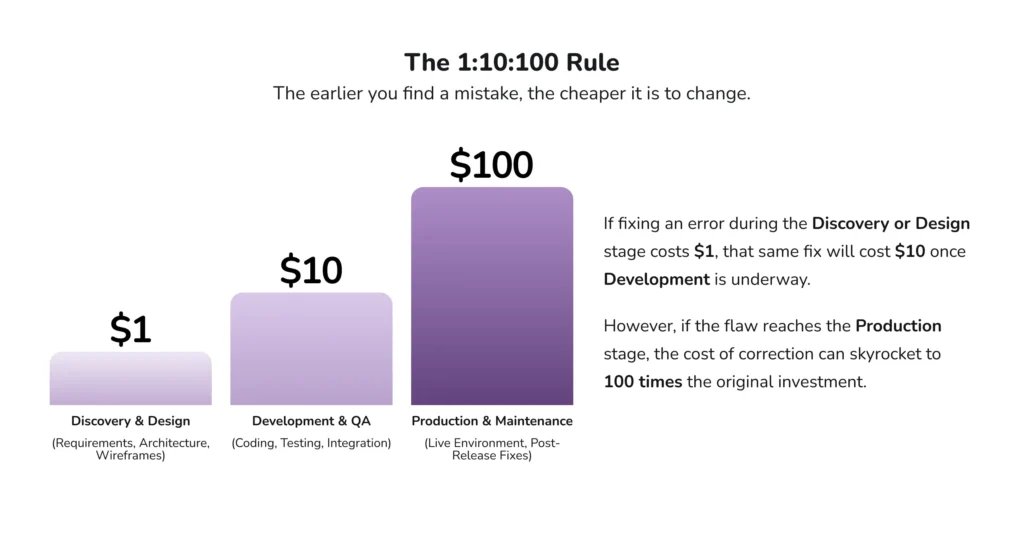
This principle is actively used in quality management and has been confirmed by the IBM Systems Sciences Institute. This is a truly effective approach that gives you a clear picture of the future project, its requirements, and expected results. If the project is only an idea, there is a high probability of “draining” the budget and releasing a product that will not be in demand or will be inconvenient to use.
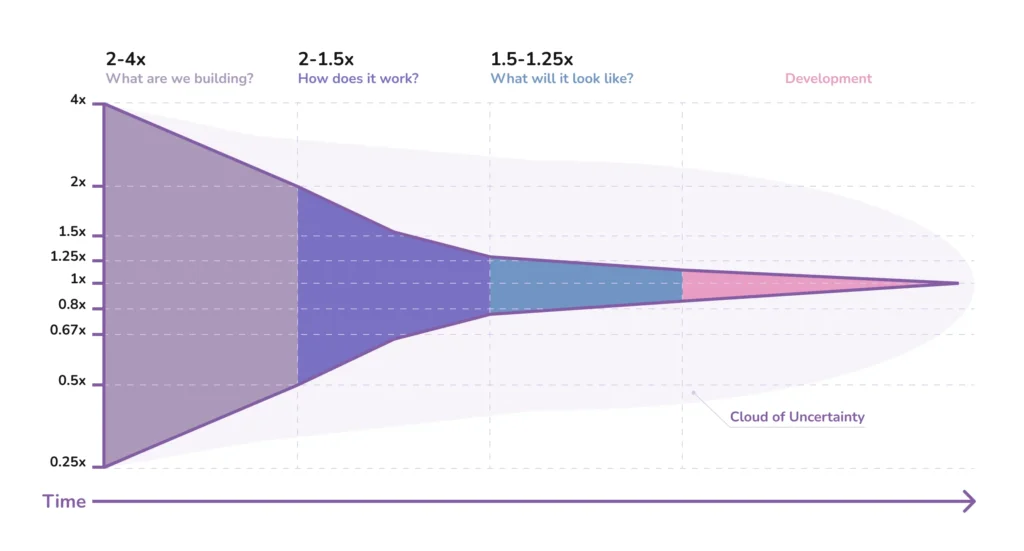
Without a project discovery phase, budget estimates are subject to high error margins. This is related to the concept of the Cone of Uncertainty. Estimates at the beginning of a project may differ by as much as 50%. Following requirements analysis and risk assessment, the margin of failure drops to 10–20%. This is a significant difference for any business.
The software product discovery phase deserves special attention. Here, not only is the technical side checked, but also the market feasibility. Do users really need these features? Do they solve a specific problem? Is the market willing to pay? It is at this stage that so-called deal-breakers are often revealed. For example:
- a third-party API does not support the necessary features;
- integration with the payment system has limitations;
- security requirements necessitate a more complex architecture;
- the planned functionality exceeds the budget.
If these issues are identified during the discovery phase of a project, the strategy can be changed without significant losses.
Drive Digital Advantage Through Disruptive Technologies
Get a precise roadmap and budget estimate before writing a single line of code.
Start Discovery PhaseThe Project Discovery Phase Deliverables
After completing the project discovery phase, the client receives a clear set of results. These are not general recommendations, but specific documents and materials. These project discovery phase deliverables form the basis for the next stages. The most important artifact is the Software Requirements Specification.
Software Requirements Specification (SRS)
The SRS is the central document that is formed during the discovery phase of a software project. This is where the idea first takes on a clear structure. If the question arises, what exactly will be created and why is it needed for the business, then the SRS includes all the necessary details:
- definition of business goals and success criteria;
- list of stakeholders and roles;
- description of the target audience;
- functional requirements;
- non-functional requirements.
Business goals are formulated not in general terms, but in measurable terms. For example, not just “launch the platform,” but “increase conversion by 20% within 6 months.” This allows you to immediately evaluate the result. The list of stakeholders helps to avoid confusion about responsibility. It is determined who makes decisions, who approves changes, and who is responsible for business processes.
Functional requirements describe what the system should do. Non-functional requirements are responsible for performance, security, and scalability. Without this, the product may work, but it may not be able to handle the load or meet security requirements. SRS reduces the risk of vague wording. Once it is approved, all parties have a common understanding of the future product.
Visual Prototypes (UI/UX)
During the discovery phase in software development, the logic of the user journey is formed. Before coding begins, a visual model of how a person will interact with the product is created. At this stage, the following are developed:
- User Flow;
- wireframes;
- basic interactive prototypes.
User Flow shows the sequence of user actions. Wireframes demonstrate the structure of screens without unnecessary design details. This allows you to focus on logic rather than colors and fonts. This approach allows you to see the product before development begins. If the scenario is complex or confusing, it becomes obvious immediately. Changes at this stage are minimal compared to reworking code that has already been written.
Market Analysis Report
During the discovery phase, a Market Analysis Report is prepared, which includes:
- competitor analysis;
- review of existing research;
- assessment of the market situation.
Competitor analysis allows you to understand what solutions already exist and what features are standard in the market. This helps to avoid creating a product that repeats the mistakes of others or does not meet current expectations.
Technical Documentation
During the discovery phase of a software project, a technical vision of the future system is formed. This is not detailed code, but a clear understanding of how the system will be built. At this stage:
- the architectural approach is determined;
- the technology stack is selected;
- a risk assessment is performed.
The architectural vision shows how different parts of the system will interact with each other. The choice of technology stack depends on the scale of the project, load, and security requirements. Risk assessment allows you to identify potential limitations. For example, the complexity of integration with external services or high-performance requirements. After that, decisions are made based on analysis, not assumptions.
Roadmap & Estimates
The final result of the discovery phase is a detailed roadmap. It includes:
- development stages;
- key milestones;
- implementation deadlines;
- budget estimates.
The roadmap provides an understanding of what will happen at each stage. Timeline and budget estimates are based on the requirements already gathered, technical analysis, and prototypes. It is the discovery phase of a software project that allows you to move from an idea to a controlled implementation process.
If the goal is to reduce risks and build a clear strategy, the logical step is to launch the discovery phase service for a software project. This approach takes into account both business goals and technical constraints and allows you to start development with a full understanding of future costs and results. If the task is to test an idea with minimal investment and quickly check demand, it is worth paying attention to the MVP approach.
Who is Involved in the Project Discovery Team?
Whenever it comes to the project discovery phase, it’s critical to recognize that several people are participating. This is where business and technology come together. For example, if you only involve developers in the project, you will get a product that is correctly constructed from a technical point of view. Similarly, if you only involve the business side, there is a risk of ignoring technical limitations.
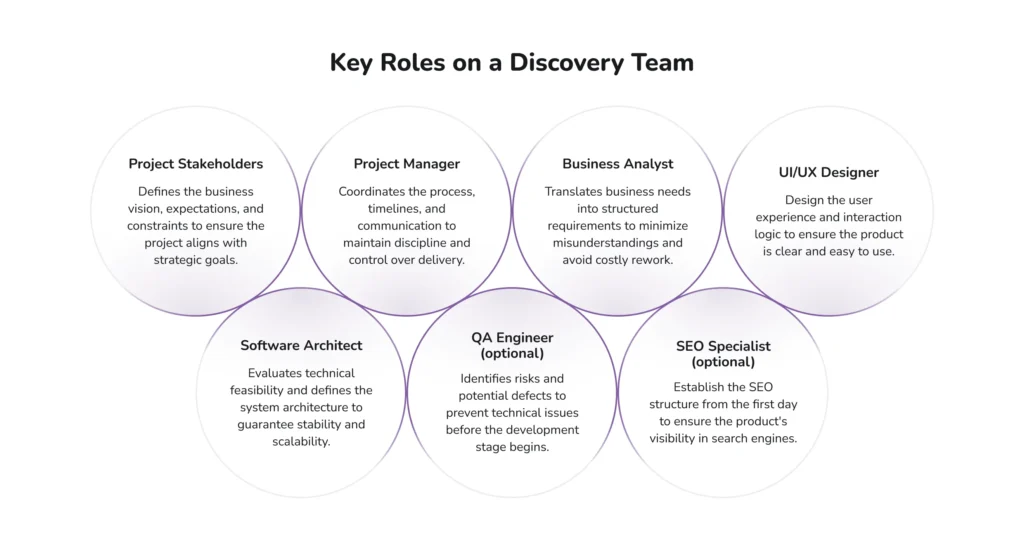
For the discovery phase of a software project to be successful, a large team with clearly defined roles must be involved in the process.
| Role | Primary Responsibility | Value for the Project |
| Project Stakeholders | Define the business vision, expectations, and constraints | Ensure alignment with strategic business goals |
| Business Analyst | Translates business needs into structured requirements | Reduces the risk of misunderstandings and costly rework |
| UI/UX Designer | Designs the user experience and interaction logic | Ensures usability and product clarity |
| Lead Developer / Architect | Evaluates technical feasibility and defines system architecture | Guarantees stability and scalability |
| Project Manager | Coordinates the process, timelines, and communication | Maintains discipline, transparency, and delivery control |
| QA Engineer | Identifies risks and potential defects | Prevents issues before development begins |
| SEO Specialist | Establishes SEO structure from day one | Ensures product visibility in search engines |
The structure of a website is established during the discovery phase of a web platform or marketplace, thus you need to hire a good SEO specialist. You could lose months of organic visibility if you make mistakes at this point.
The Step-by-Step Project Discovery Process
There is a common misconception that the discovery phase of a project is simply a series of meetings. However, it is a clearly structured process with logic and sequence. Each step has a specific goal and a specific result. If you are planning to invest in development, it is important to understand how the action plan is formed. Below is a sequence that transforms an idea into a clear implementation model. The deeper you understand the process of creating a digital product, the more you will understand the need for the Project Discovery Process.
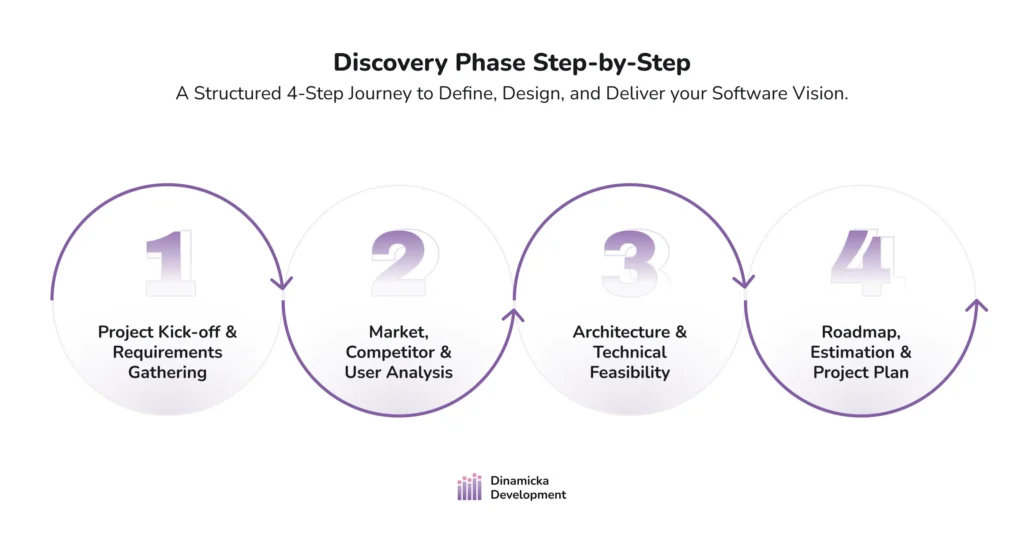
Step 1: Kick-off & Requirements Gathering
The beginning is always associated with immersion in the business context. A kick-off meeting is held, interviews with stakeholders are organized, and initial requirements are collected. At this stage, it is important not to rush and get clear answers to the following questions:
- What problem does the product solve?
- What are the business goals behind its launch?
- What are the constraints in terms of budget, time, or resources?
- What metrics will determine success?
This is where the foundation of the discovery phase in software development is formed. If the foundation is unclear, any subsequent assessment will be inaccurate. Therefore, at this stage, you can avoid a situation where the team builds functionality that looks technically correct but does not meet real business goals.
Step 2: Market, Competitor & User Analysis
The concept is then put to the test in the actual market. User Personas and User Stories are created, the target audience is determined, and competitors are examined. At this point, we can understand:
- Is there demand?
- What features already exist in competitors’ products?
- What are users’ expectations?
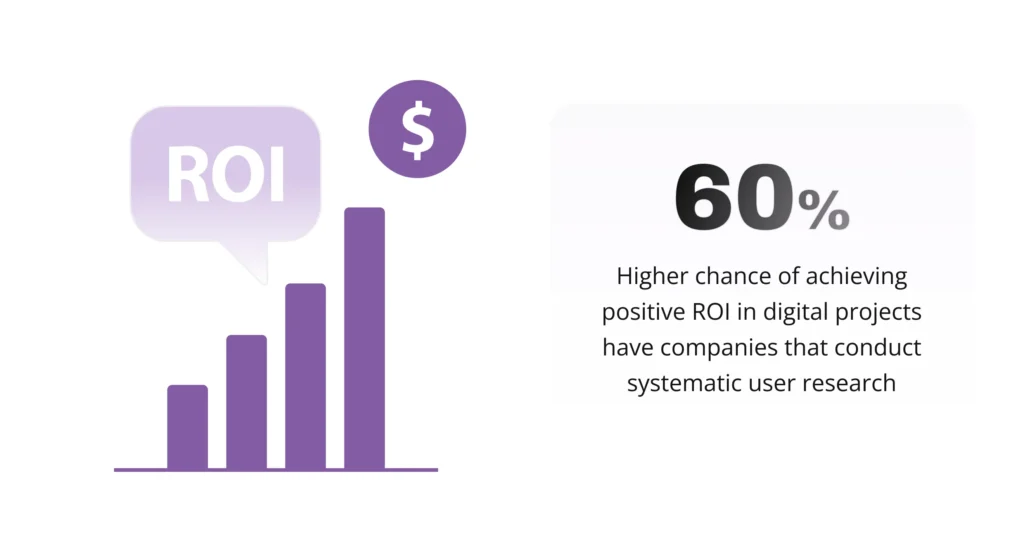
According to Forrester Research, companies that conduct systematic user research have a 60% higher chance of achieving positive ROI in digital projects. This is where the software product discovery phase plays its key role. The idea is tested by reality.
Step 3: Architecture & Technical Analysis
After confirming the business logic, we create the information architecture of the product and analyze:
- scalability options;
- security requirements;
- integration with other systems;
- third-party service limitations.
If complex integration or a high-load system is planned, critical barriers may be identified at this stage. For example, it may turn out that a third-party service does not support the required amount of data or has strict API limits. Identifying this during the discovery phase of a software project means saving significant resources. Technical analysis is not limited to the choice of technologies. It assesses risks and helps make decisions that will not cause problems after launch.
Step 4: Planning & Estimation
The final stage combines all the previous results. This is where the Product Roadmap is formed, and an accurate assessment of deadlines and budget is carried out. The project discovery phase turns into a concrete action plan, and then implementation begins with clear guidelines.
Need a Team that Understands Both Business and Tech?
Our business analysts and architects are ready to validate your idea.
Book a ConsultationIs the Project Discovery Phase Always Necessary?
The project discovery phase is not necessary for every project. There are exceptions to the rule when this stage can be skipped. It is not mandatory in the following cases:
- simple landing pages;
- small websites based on template solutions;
- minor refinements;
- when the specification is already complete and verified.
However, there are categories of projects where the discovery phase service for a software project is critical. These include:
- startups and MVPs;
- custom complex software;
- digital transformation of companies;
- high-load systems.
In such cases, the discovery phase of a software project allows you to protect your investment and minimize risks. The approach should be consultative and provide value. If you need a team that can conduct a full-fledged project discovery phase and accompany the product from strategy to release, Dinamicka will help you. We provide services in web development, mobile development, the creation of SaaS products, and CRM systems. Various businesses turn to us for a full range of services: from idea to implementation.

How to Prepare for the Project Discovery Phase
For the discovery phase to be as effective as possible, preparation on the part of the business is important. You don’t need to be a technical expert. It is enough to clearly formulate the business context. Here is a simple checklist:
- Gather existing materials. Collect sketches, presentations, old documentation, even notes. All of this will help you understand the context.
- Define business goals. Formulate a specific result. For example, reduce application processing time by 40%.
- List competitors. Prepare 2-3 examples of products you like or dislike.
- Identify constraints. Determine the approximate budget range and desired launch date.
- Identify stakeholders. Appoint a person responsible for making final decisions.
The clearer the answers to these questions, the more effective the discovery phase in software development will be.
If the goal is to reduce uncertainty, obtain a clear plan, and a realistic budget, the optimal solution would be to launch a professional project discovery phase, which allows decisions to be made based on data rather than assumptions.
Latest writings

Custom Software Development Guide: From Idea to Launch

Guide to the Technologies Disrupting Real Estate in 2026